

 Chat GPT
 Mistral
 Claude
 Perplexity
 Grok
GrokKey points at a glance:
- The CBAM requires importers to report CO₂ emissions embedded in goods imported into the European Union.
- Companies must purchase CBAM certificates corresponding to the emissions embedded in their goods.
- A transitional reporting phase precedes the full financial implementation of the mechanism.
- Importers must collect reliable data from their suppliers to ensure regulatory compliance.
The CBAM (Carbon Border Adjustment Mechanism), also known as the MACF (Carbon Border Adjustment Mechanism) or “carbon tax”, is a major reform of international trade introduced by the European Union.
It aims to put a carbon price on imports of certain products to ensure a level playing field between European producers subject to the EU Emissions Trading System (EU ETS) and importers of goods from third countries.
In the context of the ecological transition and the fight against climate change, this mechanism represents a major change for importing companies. It introduces new administrative, reporting and operational obligations, requiring adaptation of internal processes and supplier relationships.
This article provides a comprehensive and detailed guide to CBAM obligations for importers in Europe, covering regulatory, practical and strategic aspects.
What is the CBAM and why was it introduced?
The CBAM is a mechanism introduced by the European Union to apply a carbon price to imports of certain products based on their CO₂ emissions. It was designed to prevent European companies from relocating production to countries with less stringent environmental standards.
This measure is part of the European Green Deal, led by the European Commission, and was adopted as an extension of the European Emissions Trading System (EU ETS).
According to Ursula von der Leyen, President of the European Commission:
“ I welcome the political agreement reached this morning on the Commission’s proposal for a carbon border adjustment mechanism. This is a central element of our European Green Deal, aimed at preventing the risk of carbon leakage. It is a major step forward as we raise our climate ambitions. ”
Source: European Commission press release (Press Corner)
The objectives are therefore twofold:
- Reduce global CO₂ emissions
- Protect European industries from unfair competition
Which products are covered by the CBAM?
The CBAM initially covers a limited number of so-called “high-carbon-intensity” sectors.
Products currently covered:
- Cement
- Iron and steel
- Aluminium
- Fertilisers
- Electricity
- Hydrogen

Key takeaway:
| Sector | Carbon exposure level | CBAM Impact |
| Steel | Very high | High |
| Aluminium | High | High |
| Cement | Very high | High |
| Fertilisers | High | Medium to high |
| Electricity | Variable | Specific |
| Hydrogen | Emerging | In development |
Who is subject to CBAM obligations?
CBAM obligations apply to:
- Importers established in the European Union;
- Indirect customs representatives;
- CBAM declarants.
Any company importing goods covered by the CBAM (steel, aluminium, cement, fertilisers, electricity, hydrogen, etc.) must comply with the mechanism’s requirements, including emission reporting and, ultimately, the purchase and surrender of CBAM certificates.
In practice, this concerns:
- Manufacturers importing raw materials or components for their production;
- Distributors incorporating imported products into their supply chain;
- Traders carrying out international purchase-resale operations;
- International trading companies handling imported flows subject to the CBAM.
These actors must implement an appropriate organisation to collect supplier data, calculate emissions associated with imported products and ensure compliance with the reporting obligations set out in European Union regulations.
What are the main obligations for importers?
CBAM obligations break down into several key steps:
1. Register as a CBAM declarant
Importers must register with the competent authorities and obtain the status of authorised CBAM declarant.
2. Collect carbon emission data
Importers must obtain the necessary information from their suppliers to calculate emissions linked to imported products, in particular:
- Direct emissions (scope 1);
- Indirect emissions (scope 2, where applicable);
- Production data for the imported goods.
3. Submit CBAM emissions reports
Each year, importers must submit a CBAM declaration including:
- Quantities of goods imported;
- Carbon emissions associated with these imports;
- Country of origin of the products;
- The methodology used to calculate the emissions.
This declaration enables authorities to verify that imports comply with the requirements of the CBAM mechanism defined by the European Union.
4. Purchase and surrender CBAM certificates
From the definitive phase onwards, importers will have to:
- Purchase CBAM certificates linked to the imported emissions;
- Surrender CBAM certificates each year according to the declared emissions.
5. Retain and archive data
Companies must retain all supporting evidence:
- Supplier data: emissions, methods and volumes;
- Emission calculations: methods and results used;
- Customs documents: import declarations;
- CBAM declarations: reports submitted to the authorities.
These elements must be reliably archived and easily accessible in the event of an audit by the competent authorities in order to demonstrate compliance of the CBAM declarations.
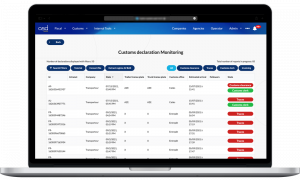
Archive your CBAM with
ASD Customs
With our dedicated ASD Customs solution, you can centralise all your customs procedures and documents in a single interface while benefiting from structured archiving that meets CBAM requirements.
What are the steps to achieve CBAM compliance?
The Carbon Border Adjustment Mechanism (CBAM), also referred to as the carbon tax, is being rolled out in two distinct phases:
Transitional phase (2023–2025)
During this period, companies must prepare for the new obligations without any direct financial impact:
- No obligation to purchase CBAM certificates;
- Quarterly reporting obligation for the relevant imports;
- Collection and transmission of CO₂ emissions data.
Definitive phase (from 2026)
From 2026, the mechanism becomes fully operational:
- Obligatory purchase of CBAM certificates corresponding to imported emissions;
- Submission of complete annual declarations;
- Financial compliance with the requirements of the mechanism.

What data must be collected?
Under the CBAM, importers must implement a reliable and structured data collection system.
Mandatory data to collect
- Product identification (CN code) which allows precise classification of the goods according to the customs nomenclature and determines eligibility for the Carbon Border Adjustment Mechanism (CBAM);
- Imported quantities of the product, expressed in the appropriate units (tonnes, kilograms, MWh, etc.), in order to measure the volumes concerned;
- Direct emissions of the product, corresponding to greenhouse gases generated during its manufacturing process;
- Indirect emissions (depending on the product), mainly linked to the energy consumed to produce the good, such as electricity;
- Calculation methodology, specifying the methods, data sources and assumptions used to estimate emissions;
- Country of production, indicating the geographical origin of the goods and identifying the applicable regulatory framework;
- Installation data of production sites, compiling information on manufacturing sites (location, industrial processes, technologies used) to ensure traceability and reliability of the declared data.
Example data collection table
| Data | Description | Source |
| Product code | CN customs code | Customs declaration |
| Direct emissions | CO₂ generated during production | Supplier |
| Indirect emissions | Electricity consumed | Supplier / energy mix |
| Imported quantity | Volume or mass | Commercial documents |
How are emissions calculated under the CBAM?
Emission calculations under the CBAM are based on standardised methodologies defined by the European Union, to ensure data harmonisation and comparability between different operators and third countries.
Simplified formula
Criteria affecting emission factors
- Product type: each product has its own carbon intensity, linked to the raw materials used and the manufacturing steps required.
- Country of production: differences in energy mix and regulation influence the level of emissions.
- Technologies used: more modern and efficient industrial processes generally reduce emissions.
What are the CBAM reporting obligations?
Reporting obligations under the CBAM are based on the regular collection and transmission of information on emissions associated with imported goods:
- Quarterly declarations (transitional phase): operators must regularly transmit data on emissions associated with imported goods to ensure progressive monitoring during the transition period.
- Annual declaration (definitive phase): a complete declaration must be submitted each year, containing all information relating to emissions and imported volumes.
- Emission justification: declared emissions must be supported by reliable and documented data to attest to their accuracy and compliance.
- Transmission via a dedicated CBAM register: all information must be centralised and transmitted through a specific register, guaranteeing traceability and monitoring of declarations.
Principles to follow for declarations
- Accurate: declared information must faithfully reflect the reality of emissions and production data, without significant errors or approximations.
- Verifiable: data must be verifiable and justifiable at any time using reliable documents and traceable sources
- Traceable: each piece of data must be traceable from its origin to its declaration to ensure full transparency.
What are the risks of non-compliance?
Failure to comply with obligations related to the carbon tax (CBAM) can result in significant consequences for importing companies, both financially, operationally and regulatorily, such as:
- Financial fines;
- Import refusal;
- Administrative sanctions;
- Customs blockage.
How to prepare effectively for the CBAM?
To effectively anticipate CBAM requirements, it is essential to structure your approach in advance and adopt best practices that secure compliance while optimising internal processes.
Key steps for CBAM compliance
- Identify covered products by determining which goods are subject to the CBAM in order to focus efforts on the flows actually affected;
- Map suppliers by analysing the supply chain to identify actors capable of providing reliable emissions data;
- Implement a data collection system by structuring and centralising the flow of information needed for emission calculations;
- Train internal teams by raising awareness among staff of CBAM obligations to ensure proper ownership;
- Automate processes by using digital tools to make calculations more reliable, reduce errors and increase efficiency;
- Implement carbon tracking tools to monitor emissions continuously in order to anticipate reporting obligations and regulatory developments.
Strategic CBAM best practices
- Integrate CBAM into the supply chain strategy;
- Work with suppliers capable of providing reliable data;
- Anticipate costs related to certificates;
- Implement internal audits.
| Step | Action | Description | Period / Timing |
|---|---|---|---|
| 1 | Identify eligibility | Check whether imported products are subject to the CBAM (cement, steel, aluminium, fertilisers, electricity, hydrogen, etc.) | Upstream |
| 2 | Register | Registration as an importer in the EU CBAM register | Transitional then mandatory phase |
| 3 | Collect data | Obtain emissions data and imported volumes from non-EU suppliers | Ongoing |
| 4 | Calculate emissions | Calculation of direct and indirect emissions according to European Commission methodologies | Ongoing |
| 5 | Report emissions | Submission of quarterly CBAM declarations | Transitional phase (2023–2025) |
| 6 | Purchase certificates | Purchase of CBAM certificates corresponding to imported emissions | Definitive phase (from 2026) |
| 7 | Surrender certificates | Annual surrender of certificates based on declared emissions | From 2026 |
| 8 | Verify and audit | Data control, verification by accredited bodies | Ongoing |
| 9 | Set up an internal organisation | Structure processes (ERP, customs, purchasing, compliance) and train teams | Ongoing |
What are the impacts of the CBAM on importing companies?
The CBAM has several significant impacts on importing companies:
1. Financial impact
The mechanism can lead to an increase in import costs, particularly due to the obligation to purchase CBAM certificates (CBAM), the price of which is linked to the carbon emissions associated with the imported products.
2. Operational impact
Compliance involves a complexification of customs processes, with additional reporting obligations and a greater need for data monitoring and management, which may require the implementation of new internal tools and procedures.
3. Strategic impact
In the longer term, the CBAM may lead to a reconfiguration of supply chains, with companies encouraged to favour more environmentally virtuous suppliers in order to reduce their exposure to emission-related costs.
According to Paolo Gentiloni, Commissioner for Economy:
“The agreement reached this morning is a decisive step towards launching the world’s first carbon border adjustment mechanism and I warmly congratulate the negotiators of the EU institutions on this historic achievement. The CBAM is at the heart of the EU’s efforts to achieve its ambitious climate objectives under the European Green Deal. It sends an important signal to producers around the world that the EU is determined to reduce emissions and expects the same level of commitment from industrial companies exporting to the EU, wherever they are located.”
Source: European Commission press release (Press Corner)
CBAM: Summary table of importer obligations
| Obligation | Description | Frequency | Phase |
| Registration | Authorised declarant status | Once | Transitional & definitive |
| Data collection | Supplier emissions data | Ongoing | Transitional & definitive |
| CBAM declaration | Emission reporting | Quarterly then annual | Both phases |
| Purchase of certificates | Carbon compensation | Annual | Definitive phase |
| Archiving | Retention of evidence | Ongoing | Both phases |
The CBAM: a major transformation for importers
The CBAM represents a structural evolution of international trade. It imposes new obligations on European importers in terms of transparency, reporting and environmental compliance.
Beyond a regulatory constraint, the CBAM also represents an opportunity:
- to optimise supply chains
- to strengthen traceability
- and to integrate carbon criteria into purchasing decisions
Companies that anticipate these obligations now will be better positioned to limit risks, control their costs and adapt sustainably to this new European regulatory framework.
CBAM FAQ: Frequently asked questions about the carbon border mechanism

What is the CBAM?
The CBAM (Carbon Border Adjustment Mechanism) is a mechanism introduced by the European Union to apply a carbon cost to imports of certain products in order to avoid distortions of competition and carbon leakage.
Which companies are affected by the CBAM?
Companies that import into the European Union products from sectors such as cement, steel, aluminium, fertilisers, electricity or hydrogen are subject to the CBAM.
Is the CBAM mandatory?
Yes. After a transitional reporting phase, the CBAM will become fully mandatory from 2026, with the purchase and surrender of CBAM certificates to cover imported emissions.
What are the obligations during the transitional phase?
During this period, importers must mainly:
- report emissions linked to imported products
- submit quarterly reports
- collect data from suppliers
When will CBAM certificates need to be purchased?
The purchase of CBAM certificates will be required from the definitive phase (2026), based on the emissions embedded in the imported products.
How are CBAM emissions calculated?
Emissions are calculated from data provided by non-EU producers, according to methodologies defined by the European Commission. Where this is not possible, default values may be used.
What happens in the event of non-compliance?
In the event of non-compliance with CBAM obligations (inaccurate declarations, absence of certificates), financial sanctions may be applied by the competent authorities.
Which documents must be retained?
Companies must retain:
- supplier data
- emission calculations
- customs documents
- CBAM declarations
Does the CBAM apply to processed products?
Yes, certain processed products containing materials from covered sectors may fall within the scope of the CBAM, depending on their customs classification.
Can carbon costs already paid abroad be deducted?
Yes, if the country of origin applies an equivalent carbon mechanism, carbon costs already paid can be deducted, subject to validated supporting documents.
Does the CBAM apply to small businesses?
Yes, as soon as they import covered products, even SMEs may be subject to CBAM obligations.
Are there any exemption thresholds for the CBAM?
At this stage, the CBAM does not provide for a general exemption threshold based on turnover or volumes, but certain specific exclusions may exist depending on the case.
How does the price of CBAM certificates work?
The price of certificates is indexed to the average price of EU ETS allowances, to ensure equivalence with the carbon cost borne by European producers.
Are indirect emissions taken into account?
Yes, for certain sectors such as electricity, indirect emissions may be included in the calculation of CBAM emissions.
What is the difference between the CBAM and a classic carbon tax?
The CBAM and a carbon tax pursue a similar objective (internalising the cost of CO₂ emissions), but their operation differs on several points:
- CBAM: European Union border adjustment mechanism applied to imports of carbon-intensive products. It is based on the purchase and surrender of CBAM certificates equivalent to the European carbon price (EU ETS).
- Classic carbon tax: direct tax applied to CO₂ emissions at national level, generally paid by producers or consumers on the territory.
In summary, a carbon tax applies within a country, while the CBAM targets imports to rebalance the carbon cost between European and imported products, in order to avoid distortions of competition and emission relocations.
CBAM vs EU ETS: what are the differences?
The CBAM and the EU ETS (European carbon market) are two complementary mechanisms of the European Union, but they apply in different contexts:
- EU ETS (Emissions Trading System): concerns installations located within the European Union. European companies must purchase emission allowances to cover their CO₂ emissions.
- CBAM (Carbon Border Adjustment Mechanism): applies to imports of products from third countries in order to impose a carbon cost equivalent to that borne by European producers.
In summary, the EU ETS targets European producers, while the CBAM applies to importers to restore fair competition and avoid carbon leakage.
Secure your CBAM compliance with ASD Group
ASD Group supports you in your CBAM compliance, secures your carbon tax obligations, makes your processes reliable and helps you anticipate the requirements of the mechanism introduced by the European Union.
Sources:
- European Commission – dedicated CBAM page (in English)
- CBAM Guidance & legislation – Taxation and Customs Union (EU) (in English)
- Guidance document on CBAM implementation (pdf in English)

Noémie Almot
Community Manager & Copywriter
Noémie is a specialised content writer at ASD Group. She creates and manages blog articles as well as news updates on our websites, with a focus on VAT, international taxes, customs operations, social regulations, and international trade. With her clear and educational writing style, she makes complex and technical topics easily understandable and relevant for businesses.

